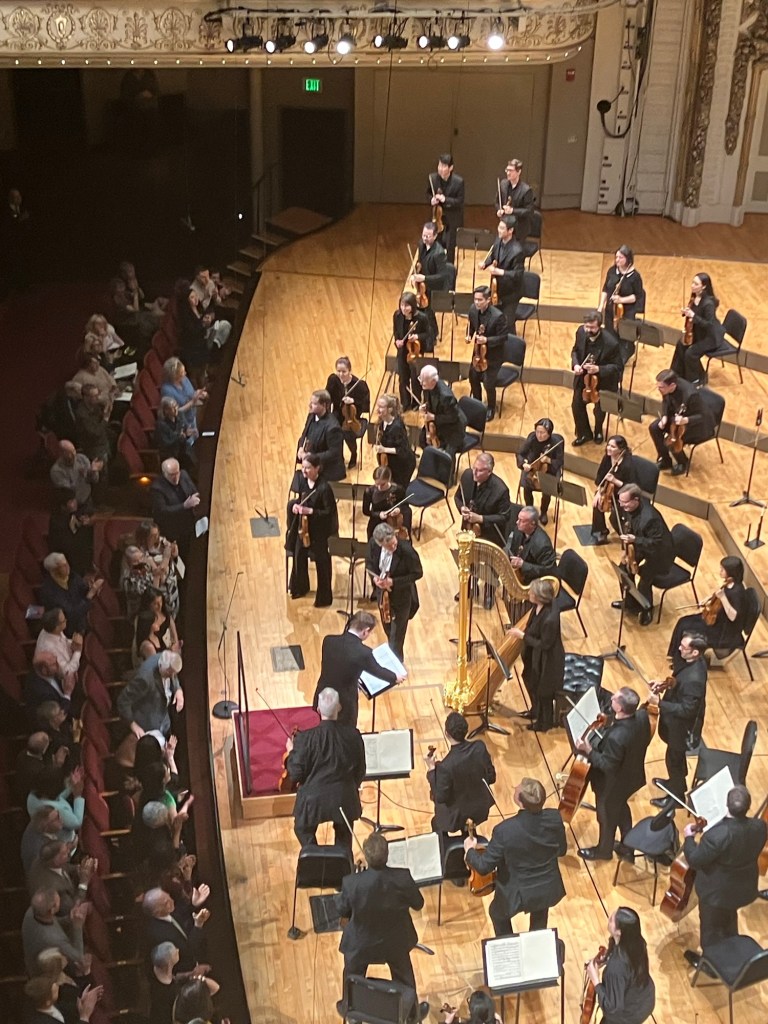
@cincysymphony continued its 2025-26 season with a spectacular program headlined by one of the most popular of late-Romantic Russian symphonies, Sergei Rachmaninov’s Symphony No. 2.
Under the direction of frequent guest conductor Ramón Tebar, artistic director of Opera Naples and principal conductor of Florida Grand Opera in Miami, the orchestra opened with a fine performance of one of the most interesting contemporary orchestral fanfares. Pulse, written by American composer Margaret Brouwer in 2003 to mark the 50th anniversary of the Roanoke Symphony Orchestra, called to mind John Adams and Philip Glass’s more recent compositions with slight hints of atonal surrealism found in György Ligeti’s music.
Canadian-American violinist James Ehnes then joined for a stunning reading of Max Bruch’s Scottish Fantasy (1880). Along with his first violin concerto, this work is one of Bruch’s most popular no doubt thanks to its soaring, familiar melodies, principally 4 different traditional Scottish folk songs. Ehnes truly captured the spirit of the piece through a joyful stage presence, a very well-balanced sense of phrasing and astonishing technical virtuosity coupled with intense rhythmic propulsion. As an encore, Ehnes treated the Music Hall audience to the opening Preludio from Bach’s third partita for solo violin.
Rachmaninov’s Second Symphony (1906-07), often regarded as one of the foundational warhorses of the Romantic repertoire, is a work the CSO has definitely taken a shine to the last few years. Maestro Tebar no doubt brought that warhorse spirit to the fore, but also brought a new, fresh sense of vitality to this evening’s performance, more so in the second movement scherzo and the fanfare figurations in the finale.
Tebar exuded unbridled joy and passion throughout, almost making him a distant cousin of Leonard Bernstein or Gustavo Dudamel in the sweep and jovial power he brought to his conducting. This was particularly prevalent in the long, expansive string melodies in the Adagio and driving percussion and brass in the first and last movements.
Bravi tutti!

 Classical Concert Reviews Cinci
Leave a comment