@cincinnatiopera opened its 2026 summer season with a truly wonderful production of Richard Strauss’s first major operatic masterpiece, Salome, its first I. Set to a libretto by Hedwig Lachmann and based on the play by Oscar Wilde, it follows the attempted seduction of John the Baptist (Jochanaan) by the stepdaughter of Herod and his execution.
The cast assembled for this production turned in spectacular performances, not least soprano Kathryn Lewek, making a welcome return to Cincinnati in her first-ever outing as the title character.
To see a soprano more associated with coloratura roles in operas like The Magic Flute, Ariadne auf Naxos and Les Contes d’Hoffmann tackle a role of Wagner-like dramatic intensity is an extremely impressive feat. Many aspects of her performance called to mind the great German soprano Waltraud Meier early in her career, especially her soaring, silvery and gleaming high tessitura and the gnarly growl she brought to the contralto-like timbre Strauss calls for.
Baritone Alfred Walker as Jochanaan brought an effervescent and commanding vocal and dramatic presence to his performance, as did tenor Zach Borichevsky as Narraboth. Heldentenor Chad Shelton as Herod brought an eerily unsettling sense of charm and self-assured power, particularly in his first major monologue in the final scene.
Mezzo-soprano Michelle DeYoung as Herodias turned out to be a more unique voice than might be expected for a role of this nature. Many times her voice e failed to carry over the orchestra and other singers as much as it could have, but her dramatic moments did call to mind the Hungarian soprano Éva Marton.
But perhaps the most fascinating aspect of this production was Erina Noda’s choreography of the famous Dance of the Seven Veils, featuring solo dancers Sydney Caggiano and Amanda Pérez Duarte. Rather than treat it as a solo ballet, as is often the case, the principal cast became dull participants in what amounted to a dramatic pantomime with balletic moments. While some might take issue with this choreography, this critic actually found it quite enjoyable, as it will no doubt encourage other choreographers to be as creatively daring.
Fine performances in smaller roles included soprano Clara Reeves as a slave (who sings for no more than 30 seconds but is much more active onstage), Emily Cotton as Herodias’s Page, Julius Ahn, Levi Capesius, Mark Hockenberry, M. Andrew Jones and Ron Dukes as a group of five Jews who argue about the nature of God, and Thom Dreeze and Andrew Gushrowski as a pair of Nazarenes.
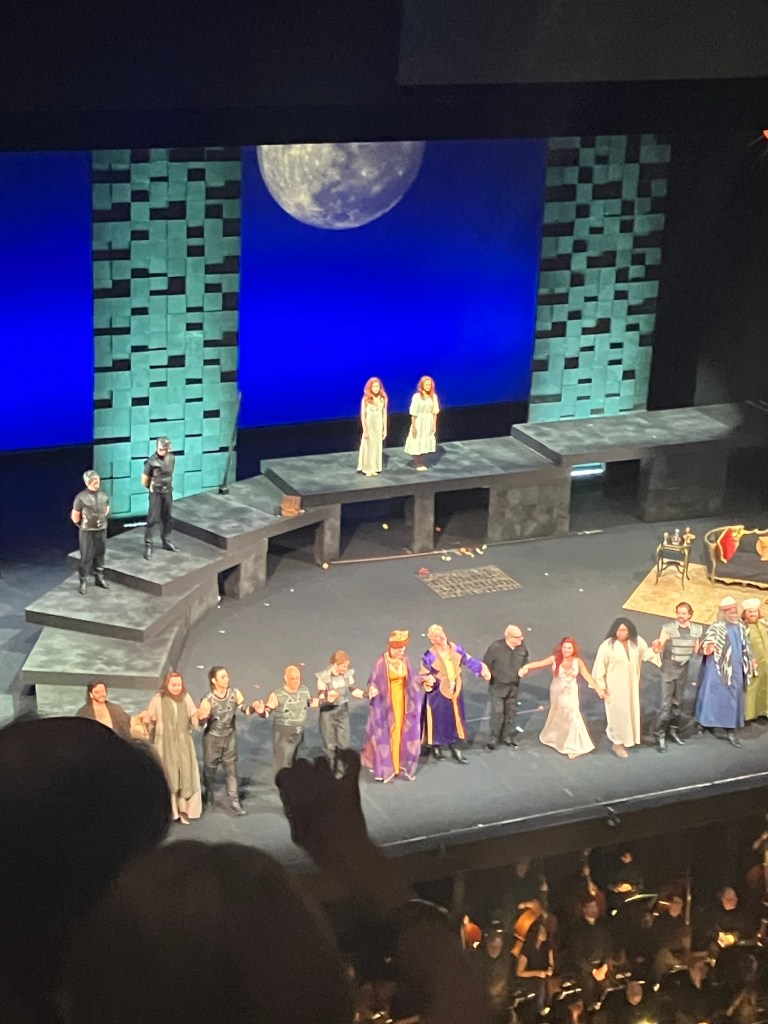
Set design, built by the San Diego Opera, hewed more closely to traditional stagings of 25-30 years prior while still being creative in other avenues, particularly its use of lighting effects and a central staircase that helps establish a foundation for the action, most evident for the former in Salone’s final monologue.
Guest conductor Robert Spano, former music director of the Atlanta Symphony Orchestra, was a spectacular choice. Having never seen him conduct opera performances prior to this evening, I felt his style was both invigorating but more relaxed than other conductors, especially in the whole of the opera’s final scene. High praise to all the CSO musicians assembled, especially its percussionists, brass and string players for pulling off one of the most demanding scores ever written with flawless precision, grace and effervescent passion.
Eagerly looking forward to the world premiere of the first work in @cincinnatiopera’s Black Opera Project, Lalovavi, on July 11. Bravi tutti to all!

 Classical Concert Reviews Cinci
Leave a comment