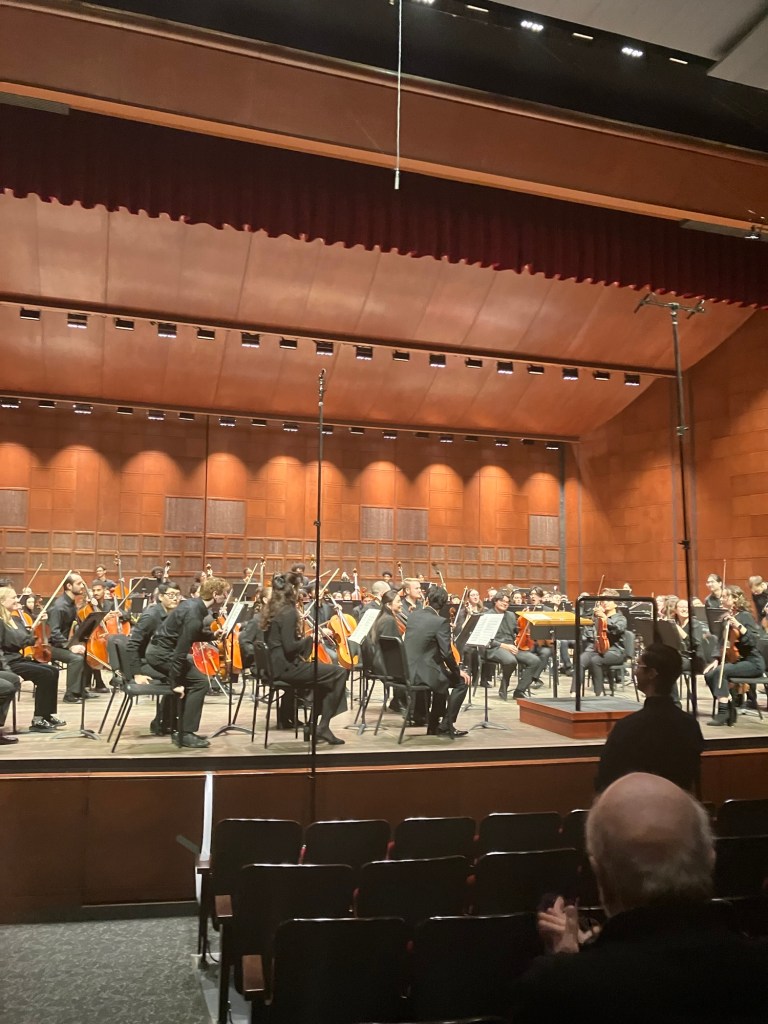
@uc_ccm’s Philharmonia opened its spring 2025 semester of performances with a program titled Wishful Thinking, pairing two uniquely different orchestral takes on the theme of spring. The first came in the form of Schumann’s ‘Spring’ Symphony (No. 1, written in 1841). The Philharmonia’s performance was wonderfully ebullient and wistful, in particular the first, third and fourth movements. While it definitely felt as compact as a Beethoven symphony in terms of form, it never felt lacking in memorable melodies and an overall spirit of happiness.
The other side of the spring coin followed in what is perhaps Igor Stravinsky’s most well-known and popular baller score, The Rite of Soring. Famous among music historians for its 1913 premiere in Paris leading to a near-riot, it is among Stravinsky’s most inventive works from the early part of his career.
Tonight’s performance in Corbett Auditorium was spellbinding and full of unsettling yet captivating moments. Foremost anong them were the many solo opportunities for winds through the work, including the haunting opening bassoon solo, clarion-like calls from e-flat clarinet and darker, more scintillating moments for cor Anglais and bass clarinet.
The Rite of Soring also proved an equally taxing score for brass, percussion, with moments of blazing triumph for trombones, piccolo trumpet, timpani and tam-tam and haunting, horror-tinged writing for the uppermost violins in the opening pages of part two.
Of course one drawback to playing The Rite of Spring is the constant shifts in meter and its overall demands for every player in the orchestra. But the assembled CCM student musicians gave it their all (about 1000-2000%, in this critic’s opinion) to play this music with the technical agility and full-throated strength of many of the greatest professional orchestras throughout the United States and perhaps Europe.
I eagerly look forward to more excellent performances from this fantastic ensemble in the months to come, particularly February and March.

 Classical Concert Reviews Cinci
Leave a comment